Latest news from SPPC
Palliative Care on the Ballot: An Election Hustings
 Monday 23 March, 6.30pm - 8pm, MS Teams. Register here.
The Scottish Partnership for Palliative Care, Marie Curie, Children’s Hospice Across Scotland (CHAS) and Hospice UK, are jointly holding an Election Hustings. The event brings together the sector at a pivotal moment in the election campaign to speak with a united voice about what matters most at the end of life.
The hustings will demonstrate the central role of palliative and end of life care in social care, the NHS, hospices, voluntary sector and wider public services.
With an ageing population, rising levels of need and persistent gaps in access and quality, palliative care is not a marginal issue. This event will highlight the inequities people face depending on their characteristics, circumstances and diagnosis, and make the case for urgent action.
Taking place online, the hustings will be accessible to stakeholders across the country. It offers a unique opportunity to secure public commitments from parties on funding, systemic reform and practical solutions that ensure everyone can experience the best possible care at the end of life.
We will be joined by representatives from political parties:
- SNP: Speaker to be confirmed
- Scottish Conservative and Unionist Party: Dr Sandesh Gulhane MSP
- Scottish Labour Party: Jackie Baillie MSP
- Scottish Greens- Gillian Mackay MSP
- Scottish Liberal Democrats: Alex Cole-Hamilton MSP
- Reform UK: Graham Simpson MSP
More Information
Find out more and register to attend the hustings here: Election Hustings information and registration
If you would like to submit a question to help guide discussion at the hustings, you can do so here: Audience Question Submission
If you have any questions, please email liam.challenger@mariecurie.org.uk
Annual Conference - From System Holes to Whole Systems
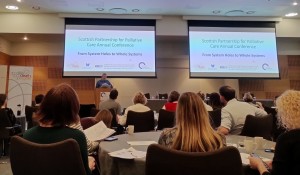 Over 100 people attended the SPPC Annual Conference, hearing from a range of inspiring speakers and participating in a variety of breakout sessions.
The day explored the fact that as someone approaches the end of life they may need a range of supports – from health services, from social care services, from the welfare system, and from family, friends and their communities. The conference looked at how this complex web of supports can work more effectively as a system to improve people’s experiences of living with serious illness, dying and bereavement.
Presentation slides from the conference can be viewed on the SPPC Conference webpage, including a film of Cormac Russell’s presentation and a podcast sharing Donald Macaskill’s key reflections.
Assisted Dying Bill - latest updates

Update - 18 March
The Scottish Parliament voted to reject the Assisted Dying Bill. Votes were 57 for, 69 against, 1 abstained, 2 did not vote. Voting results can be viewed here.
The SPPC sent a final briefing to MSPs on 16th March ahead of the final vote on 17th March.
Update lunchtime 16th March
Following three days of debate the final version of the Bill has been published. It contains a few technical errors which should be sorted at the start of the final debate and vote happening tomorrow.
With SPPC support Bob Doris MSP proposed 47 amendments to the Bill. A large majority of these were voted through by MSPs and have been incorporated into the Bill. A table listing all the amendments (and their fate) can be downloaded here.
Update lunchtime 12th March
The debate on amendments is now expected to last for 4 days. This update takes stock after 2 days of debate and voting, focusing on the outcome of amendments developed by SPPC together with Bob Doris MSP, who proposed them in debate. A lot of other amendments referencing palliative care also passed. We’ll do a full analysis of these in due course.
The following changes have been made to the Bill and will become law, should the Bill be supported in the final vote on 17th March.
Prognosis
An amendment by Daniel Johnson MSP together with 3 amendments from Bob Doris have the effect of restricting eligibility for AD to people “who can reasonably be expected to die within 6 months”.
Coercion
Parliament has voted for amendments to the Bill that:
- require the assessing doctor to “enquire about and discuss any indirect pressures which may limit the person’s ability to decide freely to request to be lawfully provided with assistance to end their own life”. Indirect pressures may include, but are not limited to, a person’s beliefs about themselves, society’s expectations, the significant absence of health or social care services to meet the person’s needs
- require the assessing doctor to have regard for any relevant professional guidance on decision making, including the impact of indirect pressures and other factors affecting free choice
- broadens the use of “coercion” throughout the Bill so that it can related to indirect pressures (in addition so something “done by a person”).
Palliative care referral
Parliament has voted for amendments to the Bill that:
- require the assessing doctor to ascertain whether the person seeking AD has been offered palliative care appropriate to their terminal illness (a parallel amendment relating to social care was added by Pam Duncan Glancy MSP at Stage 2)
- require the assessing doctor to refer the person seeking AD to a palliative medicine specialist for assessment if:
- they have not been offered or received appropriate palliative care, or
- they have uncontrolled symptoms or fear of uncontrolled symptoms
A person referred in these circumstances who decides not to take up the referral would not be ineligible purely as a result of not attending, but the doctor assessing their eligibility for AD could take their non-attendance into account.
Assessment
Parliament has voted for amendments to the Bill that:
- require the doctors assessing a person’s eligibility for AD to produce a report describing the evidence gathered to inform the AD assessment and their reasons for the judgment they reached
- reduces discretion of assessing doctors and makes for a more consistent assessment process by making the following mandatory rather than optional:
- the things the assessing doctor must explain and discuss, and inform about [includes, diagnosis, prognosis, treatments (and impacts), about palliative and other care, the substance to be used & how it will cause death, that they can be referred to a social worker, steps in the AD process including cancellation].
- the things the assessing doctor RMP must advise the person (to tell their GP, and to discuss the request with those close to them).
Update, 9 March 2026
SPPC has prepared a briefing for MSPs (and others) on proposed amendments to the Assisted Dying Bill. Around 60 pages of amendments will be debated and voted on at the Parliament on Tuesday 10th March.
Update, 2 March 2026
Timeline on amendments and votes
The deadline for MSPs to submit amendments to the Assisted Dying Bill is noon on 3rd March. The Daily Lists of Amendments lodged can be viewed here. The debate and vote on amendments will start on 10th March. The debate and final vote on the Bill will be sometime the following week.
SPPC has worked with Bob Doris MSP to develop many amendments to the Bill at Stage 3. We will publish a full listing of these amendments on our website very soon, once these have been lodged with Parliament.
Scottish Government view on Financial Memorandum
The Cabinet Secretary for Health and Social Care has written to the Health Social Care and Sport Committee giving the SG view of the Financial Memorandum produced by the MSP in charge of the Assisted Dying Bill. The lengthy analysis states “ Scottish Government does not agree with the assumption that much of the provision of assisted dying would be absorbed into existing budgets or the conclusion that the Bill will have minimal cost implications.”
Update, 23 February 2026
CMO reply to Dr Annabel Howell - removal of clauses
The Chief Medical Officer has replied to Dr Annabel Howell’s letter in which she had highlighted concerns about the intended removal of clauses from the Assisted Dying Bill prior to the Stage 3 vote. You can view the CMO’s letter here: CMO letter to Dr Annabel Howell
In his reply the CMO confirms the sections of the Bill which are problematic in terms of being outwith the legislative competence of the Scottish Parliament. The clause about the approval of substances to use in an assisted death will be dealt with by a S30 order which grants Scottish Parliament temporary powers. The clause will therefore be included and voted on in the Bill.
The CMO confirmed that other clauses deemed to be problematic are those relating to: conscientious objection; employment protections; no duty to inform about AD; the qualification /experience required of doctors doing an assisted death; and the role of pharmacists. These issues are the subject of ongoing discussion between SG and Westminster and seem likely to be removed from the Bill prior to the final debate and vote. If the Bill passes then some sort of clauses will be added subsequently by the Westminster Government using a S104 order. An explainer on S30 and S40 orders can be read here: S30 and S40 orders.
The letter does not answer SPPC’s questions about the timeline and process by which clauses on these issues would be developed if the Bill passes or what opportunities stakeholders will have to input. However the CMO gives his view that “it would be essential to involve clinicians, including those providing palliative care and care around death, as well as others involved in service delivery, in the development of any guidance required to support implementation.”
Joint consensus statement
Seven other other medical and healthcare membership organisations in Scotland have signed a joint consensus statement raising concerns about similar issues to those raised by the SPPC Specialist Palliative Care Group:
- Removal of key safeguards from primary legislation
- Risk to professional confidence and public trust
- Inadequate scrutiny of consequential provisions
- Implications for safe and ethical implementation
More information is available here: Proposed changes to Assisted Dying for Terminally Ill Adults (Scotland) Bill
Update, 17 February 2026
Letter from SPPC Specialist Palliative Care group to Chief Medical Officer - concerns about removal of clauses
Dr Annabel Howell, Chair of the Scottish Partnership for Palliative Care Specialist Palliative Care group, has written to the Chief Medical Officer to highlight concerns about the intended removal of clauses from the Assisted Dying Bill prior to the Stage 3 vote. The relevant clauses relate to the regulation of health professionals. You can view the letter here: Letter from Dr Annabel Howell to Chief Medical Officer
Update, 9 February 2026
Letter from Neil Gray to Convenor of HSCS Committee
Scottish Government has written to the Convenor of the HSCS Committee to set out how it intends to try to deal with aspects of the Assisted Dying bill which fall outwith the legislative powers of the Scottish Parliament. In addition the letter confirms that SG will table some amendments dealing with other “technical and practical inconsistencies” in the Bill. Finally SG has said that it will produce a “critique” of the most recent version of the Financial Memorandum (Dec 2025) which aims to set out the costs and savings associated with the Bill. The full letter is available here: Cabinet Secretary Health and Social Care letter regarding Stage 3 handling of the Assissted Dying Bill
Update, 26 January 2026
Developments on conscientious objection and medicines to be used
The Cabinet Secretary for Health and Social Care has written to the Convener and also discussed with the Health Social Care and Sport Committee (see meeting papers and video) two topics in the current Bill which are outwith the scope (“competence”) of what the Scottish Parliament can legislate on. The two areas are medicines regulation (specifically in the Bill the use of substances to end someone’s life) and regulation of healthcare professionals / employment protection (specifically in the Bill conscientious objection).
The two issues are being dealt with in different ways, both of which require a decision by Westminster to extend powers to the Scottish Parliament. A “Section 30 order” has been requested by SG in respect of medicines regulation. If granted by Westminster this will allow the Bill to retain clauses on medicines regulation which can then be voted on by the Scottish Parliament. However, in the case of conscientious objection SG has requested a “Section 104 order”. This order only confers powers to the Scottish Parliament if and when the AD bill is passed and has received Royal assent.
In practical terms all clauses relating to conscientious objection will have to be removed from the Bill and will not be scrutinised or voted on by the Scottish Parliament. The Bill would be passed without any conscience clauses or employment protections for health and social care professionals. There is no information available yet on what will be removed, nor about the process which will produce the conscience clauses which will then be grafted onto the Bill after Royal assent.
This letter from the Office of the Secretary of State for Scotland (the UK Government Minister) provides some explanation for the approach to these matters, although it is not entirely clear why a different approach is being adopted on the 2 issues.
Update, 9 December 2025
Stage 3
The Bill has entered Stage 3 at which there is a further opportunity for MSPs and Scottish Government to propose amendments. The amendments are voted on by the whole chamber and then the final version of the Bill is debated and voted on for a final time. The timelines for Stage 3 are not yet published, but there are some official indications that the final debate may be late February or early March 2026.
Letter to UN Committee on the Rights of Persons with Disabilities
Following a vote of the HSCS Committee the Convenor has written a letter to the UN Committee on the Rights of Persons with a Disability seeking a view on the compatabiity of the Bill with the UN Convention on the Rights of Persons with Disabilities
Revised estimates for costs of assisted dying – reflecting amendments at Stage 2
A revised financial memorandum can be viewed here: Revised Financial Memorandum reflecting amendments at Stage 2
Assisted Dying in England
The report of the Terminally Ill Adults (End of Life) Bill House of Lords Committee is now available. Read the report in full here.
Stage 2
The Assisted Dying for Terminally Ill Adults (Scotland) Bill has now completed Stage 2, during which the Health, Social Care and Sport Committee (HSCSC) debated and voted on amendments.
All the transcripts and video of the four meetings of the committee can be viewed here.
You can see the Bill as it now reads following amendment here.
SPPC has worked in various ways to input into Stage 2 of the Bill:
- A short film about SPPC’s approach to amendments
- An explanation of SPPC’s approach and the intent of its suggested amendments
- The actual amendments lodged by Bob Doris which were considered by the Health, Social Care and Sport Committee
- A summary of the outcomes of SPPC suggested amendments - those rejected and those supported by the HSCSC
- Listing of all the changes made to the bill at Stage 2
- A letter from Mark Hazelwood, CEO of SPPC to Liam McArthur MSP regarding the definition of coercion used in the Assisted Dying Bill.
- SPPC have co-signed a letter to Scottish Parliament requesting time for adequate scrutiny of the Bill between Stage 2 and Stage 3.
Photo: Mogens Engelund
Summary of the Outcomes of SPPC Amendments to the Assisted Dying for Terminally Ill Adults (Scotland) Bill
SPPC worked with Bob Doris MSP to submit over 40 amendments to the Assisted Dying for Terminally Ill Adults (Scotland) Bill.
Changes Proposed by SPPC/Bob Doris MSP and Agreed by the Committee
Reasons for Seeking an Assisted Death
The Coordinating Medical Practitioner (CMP) must as part of the assessment process “enquire about and discuss the person’s reasons for wishing to be lawfully provided with assistance to end their own life”. Strangely the Committee also voted against SPPC amendments requiring the reasons to be documented in the Statements which conclude the AD assessment (and sanction AD).
Social Work Assessment
The CMP must inform the person seeking AD that they can ask to be referred for a social work assessment, and inform them of the potential benefits of such an assessment.
Reducing the discretionary nature of referral for specialist opinion during assessment for AD
Where the CMP has any doubt about the capacity of a person seeking AD they MUST refer the person to a specialist. (previously the Bill said “MAY refer”).
Where the CMP has any doubt about whether the person seeking AD is “terminally ill” they MUST refer the person to a specialist. (previously the Bill said “MAY refer”).
Changes Proposed by SPPC/Bob Doris MSP and Rejected by the Committee
Definition of terminal illness
SPPC amendments to insert a 6-month prognosis into the definition were rejected.
Coercion
SPPC amendments to insert a definition of coercion into the Bill covering undue pressure or influence from: “the person’s own beliefs about themselves; any other person; the expectations of society; the health and social care system; the state.” were rejected.
Mandatory Referral to Specialist Palliative Care
Amendments to require anyone seeking AD to be referred for a specialist palliative care assessment were rejected. However, an amendment by Jackie Baillie MSP requiring the CMP to inform the person seeking AD that “that they can be referred for a palliative care assessment to explore whether any additional support could be provided to them” was agreed.
Reducing the discretion of the CMP in terms of what may be explained, discussed and advised during assessment
An amendment was rejected which would have required the CMP to explain and discuss the following (the Bill currently allows the CMP to explain and discuss these topics “in so far as the CMP considers appropriate”: the person’s diagnosis and prognosis; any treatment available and likely impact of it on the person’s terminal illness; any palliative or other care available; the nature of the substance that might be provided to assist the person to end their own life (including how it will bring about death).
A similar amendment would have required, without qualification, the CMP to advise the person to: inform their GP they are seeking AD; discuss the request with those close to the person.
Vulnerable Adults
SPPC amendments which would have required the CMP, as part of the assessment, to ask the relevant local authority whether they held any information which might indicate whether a person might have a preexisting vulnerability was rejected. Related amendments which would have mandated a referral for social work assessment if vulnerability was identified or suspected was rejected.
CMP Assessment Report
SPPC amendments requiring the CMP to produce a report detailing:
- The reasons the person gave for seeking AD
- What evidence was gathered and used to inform the decision
- The reasons the practitioner reached their judgement
were rejected.
Protracted Dying
SPPC amendments to require SG to make regulations about handling cases where death does not follow the taking of the lethal substance within a reasonable time frame were rejected.
Administration and regulation of assisted dying services
SPPC amendments requiring that SG produce regulations about the regulation and oversight of persons who carry out AD under the act, to ensure the safety and wellbeing of the people provided with AD including: regulation of settings where AD may or may not take place; the role of HIS and the Care Inspectorate in regulation and scrutiny; and a process to raise concerns about the provision of AD to a person were all rejected.
Amendments to Assisted Dying Bill
SPPC is seeking changes to the Assisted Dying for Terminally Ill Adults (Scotland) Bill by encouraging and supporting MSPs to submit relevant amendments and/or by supporting relevant amendments developed by other organisations.
The changes we hope to see reflect the points SPPC has previously raised with the Parliament in written and oral evidence.
SPPC’s suggested amendments focus on:
1. Strengthening safeguards for vulnerable people (as well as specific groups this means potentially anyone towards the end of life).
2. Protecting and promoting the practice and provision of palliative care.
In formulating possible changes SPPC’s primary concern has been the safety of individuals. The resource implications of particular amendments has not shaped SPPC’s approach to the Bill.
You can read more detail of SPPC’s suggested amendments in the documents below:
- An explanation of SPPC’s approach and the intent of its suggested amendments
- The actual amendments lodged by Bob Doris which will be considered by the Health, Social Care and Sport Committee
 RSS
RSS