Latest news from SPPC
SPPC Member briefing: Public Service Reform – what is it and what might the implications be for palliative care?
This member briefing by SPPC CEO Mark Hazelwood on public service reform will help explain the term, provide a brief history of PSR, and outline recent developments. It includes speculation on future development and considers some of the implications for palliative care.
Read the briefing in full here.
A call for cross-party action on palliative care
The SPPC has written to the leaders of all Scottish Parliament political parties urging cross-party action on palliative care.
In his letter, Mark Hazelwood, Chief Executive of the SPPC, highlights that debates around the Assisted Dying Bill identified a remarkable cross-party consensus that Scotland must do better in its provision of palliative care. This consensus was also evidenced in the range of commitments contained in party manifestos at the recent election.
Within the letter, the SPPC asks that all parties:
- build on this consensus and work collaboratively over the life of this parliament to achieve the step change that is so urgently needed.
- support the development of national standards for palliative care.
- support a review of the resources required for meaningful change.
You can read the letter in full here: Letter to party leaders calling for cross-party action on palliative care
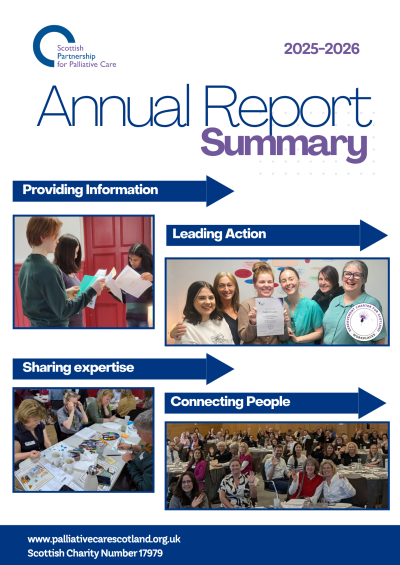
SPPC Achievements 2025-26
SPPC has produced an Annual Report Summary which sets out our work and impact during 2025-26. The report also summarises the key work we are now delivering during 2026-27.
Read the Annual Report Summary 2025-26 in full here.
New SPPC 3-year strategy
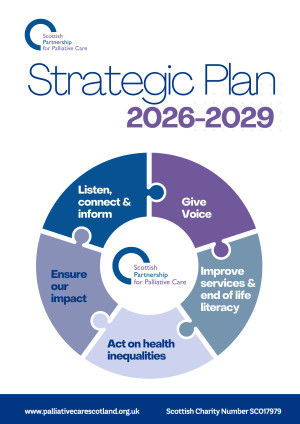 SPPC has published a new Strategic Plan 2026-2029 which will guide how we allocate our time and resources to maximise our impact. The strategy has been informed by input from members, surveys of our public and professional stakeholders and a review of our previous strategy. Thanks to everyone who has contributed. You can download the strategy here.
Our five strategic aims are to:
- Listen to, connect and inform stakeholders
- Give Voice
- Improve Services and End of Life Literacy
- Support recognition of, and action on, health inequalities
- Ensure Our Impact
SPPC has also published its Annual Plan for 2026-27. You can download it here and see more detail of the outputs we intend to deliver over the next 12 months.
Scottish Parliament elections: Palliative care in party manifestos
Prior to the upcoming Scottish Parliament Elections on 7 May, several political parties have made references to palliative care within their party manifestos. SPPC is independent of party politics and abides by the legal frameworks which apply to charities during electoral periods.
For information, we’ve provided below links to all the major parties’ manifestos where ‘palliative care’ is explicitly mentioned (and quoted the relevant content in each).
Scottish Conservatives
2026 Scottish Parliament Election Manifesto - Scottish Conservatives
“For those with terminal illnesses, we must do better to care for them as they enter the final stages of their life. We welcome the publication of the Palliative Care Matters for All strategy 2025-2030 but know that strategies alone will not improve care – it is delivery that counts. So we would ensure this strategy is backed up with a new funding model to deliver the palliative care our country deserves.”
Scottish Greens
2026 Scottish Greens Manifesto - Scottish Greens
“It is vital that we also support people to die well and we need to have honest conversations about what a good death looks like. Palliative care has been neglected for too long and we will invest in services so that people can access help and support in their community, 24/7.
• Deliver a long-term, sustainable funding model for hospice care, including fully implementing pay parity between NHS and hospice care staff.
• Establish an independent review of palliative care to drive urgent system reform and identify investment needed to meet rising population needs, expand community-based care and reduce avoidable hospital use for those as the end of life.
• Ensure all patients, carers and health and care staff have access to a 24/7 palliative care helpline to get support and specialist advice.
• Make training in palliative care a mandatory requirement for all workforces supporting a terminally ill person, including care home staff and social care staff, with provision for unpaid carers.”
Scottish Liberal Democrats
2026 Manifesto - Scottish Liberal Democrats
“Give people dignity at the end of life by:
• Supporting hospices to provide essential palliative and end-of-life care, enabling them to pay doctors and nurses in line with NHS salaries and giving children’s hospice care a fair deal, building on the extra £14.4m delivered by Scottish Liberal Democrats across the last two Scottish budgets.
• Giving people of all ages living with terminal illness a legal right to palliative care.
• Helping people with terminal illness with energy bills amid the cost of living crisis, and giving them fast-track access to the emergency insulation programme set out in chapter 12.”
Scottish Labour
Manifesto 2026 - Scottish Labour
Improving end of life care
“Too many people are reaching the end of life without the support they need. Compassionate and well planned palliative services give patients comfort and care when they are terminally ill.
Scottish Labour will:
• End the patchwork provision of palliative care, working with the profession to improve clinical pathways and minimum standards of care for those at the end of life.
• Improve palliative care training, for staff in social care and health services, including NHS 24, so patients and families get the advice and support they need.
• Better coordinated care in the community, with family GPs delivering improved continuity of care.
• Deliver parity of pay for hospice-based doctors and nurses, with a long-term sustainable funding model for hospices and end of life care.”
SNP
SNP 2026 Manifesto: Always on Scotland’s side — Scottish National Party
Framed as ‘Palliative care expansion’ in the contents page
Palliative care
“Anyone who needs palliative care should have access to the best quality support. We will work with all interested parties to make sure that appropriate palliative care is available for all those who need it, where and when they need it.
We will continue to deliver our Palliative Care Matters for All Strategy and build on the investment made in our hospices to introduce NHS pay parity for hospice staff and increase funding to £9.4 million this year. We will guarantee that pay parity is maintained throughout this parliament.
Going forward we will co-develop a new funding model for Hospices with the sector to ensure annual public funding keeps pace with need. That will include exploring if the most appropriate model is direct funding for hospices in recognition of the key role they play in the provision of palliative care. We will work with the NHS and specialist charities to explore ways to expand the palliative care workforce, and provide more consistent palliative care for those who need it.
We will also deliver a new Paediatric Palliative Care Suite for Scotland - or ‘Molly’s Suite’ - building on the incredible work done by young cancer patient Molly Cuddihy to ensure children and young people at the end of their life are properly supported and treated with dignity. This will complement the exceptional work done by CHAS to support children, young people and their families in Robin House and Rachel House.”
Home Energy for Health
“The use of life saving equipment at home and not having to either visit or stay in hospital, should not leave anyone out of pocket.
That’s why we will work to support the cost of electricity for the use of life saving equipment that has been prescribed for use within their home. As part of our efforts to improve palliative care we will also ensure that this electricity support is applied to the energy bills of terminally ill patients, to relieve this worry from their final days.”
 RSS
RSS